How to Leave a Comment
Thursday, June 3, 2010
Saturday, May 29, 2010
GOODBYE TROUT!!!!
and hiked out to the creek behind Caroline.
Wednesday, May 26, 2010
8 Square School House
(click on any photo to get a closer look)
Once inside, the boys were instructed to sit on one side of the room and the girls on the other. "Backs against the back of the chair and both feet flat on the floor. Gentlemen, if you cross your legs, you will sit with the girls."
Later, on this HOT day, the students learned how to pump water from the well. Here, Ilana pumps for Bailey.
The teacher thought the boys deserved to have the bucket of 42 degree water poured on them. They actually loved it!
The teacher also warned that this was their bathroom break. Here, Rosa and Tieana check out the outhouse:
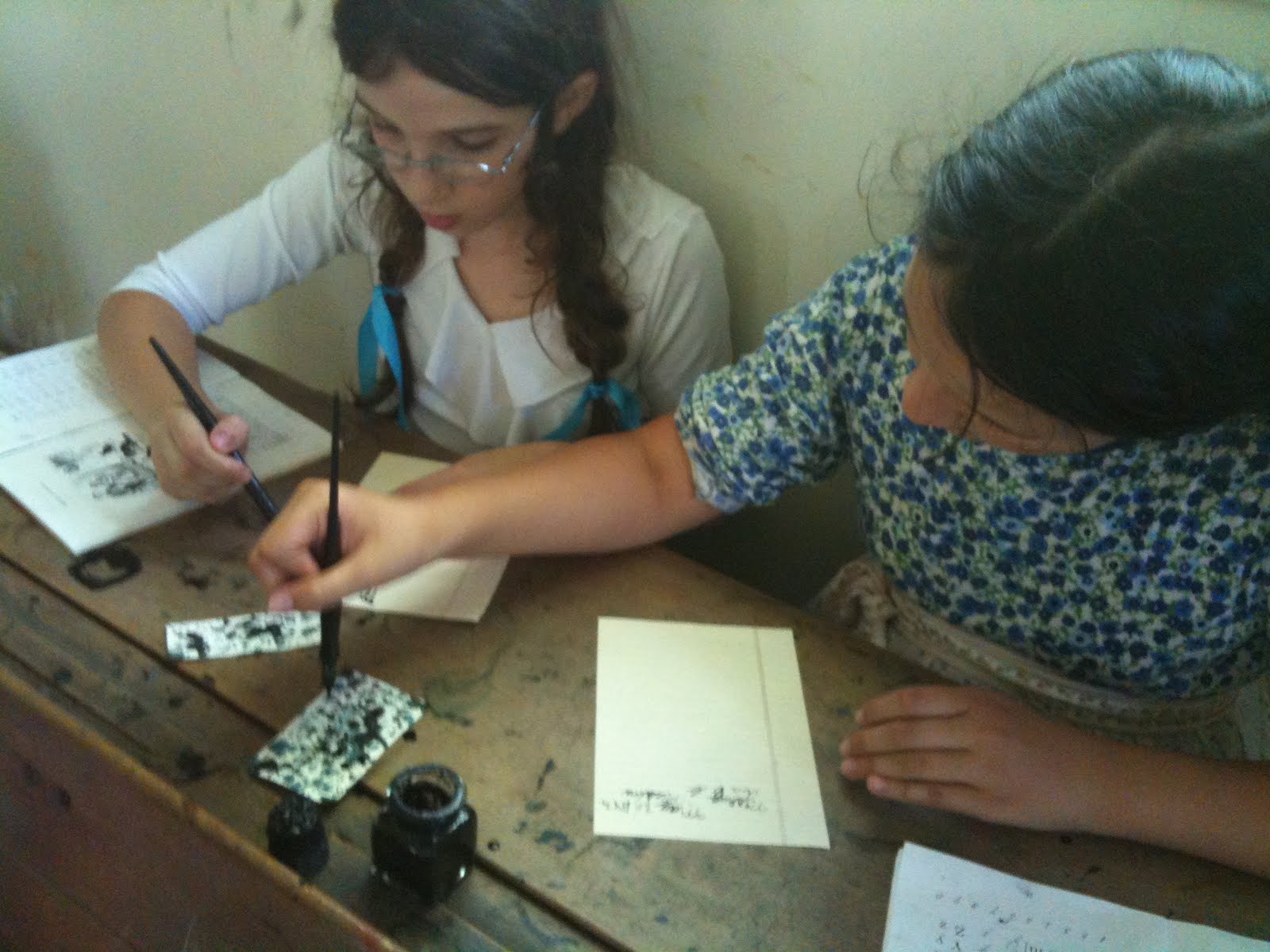
After recess with one swing, stilts, ball and cup games, and the nature around us, we went back into the schoolhouse to work on our "penmanship," with real bottles of ink!
Here's a group photo in front of the school: 1892.
Monday, May 24, 2010
Thursday, May 20, 2010
Finding Volume
Wednesday, May 19, 2010
Mass
Thursday, May 13, 2010
The Scientific Method
We learned that the 5 steps of the scientific method are:
1) Pose a question.
2) Make a hypothesis (an educated guess that can be tested).
3) Test the hypothesis.
4) Analyze the results.
5) Make a conclusion.
We wondered whether certain balls would sink or float. Given a tennis ball, golf ball, ping pong ball, marble, wooden ball, rubber ball, styrofoam ball, ball bearing, and a clay ball, we hypothesized about each ball's outcome. Then we tested them in a container of water! After taking data on a chart, we analyzed the results, finding that the tennis ball, ping pong ball, wooden ball, and styrofoam ball floated while the golf ball, marble, rubber ball, ball bearing, and clay ball sank. Lastly, we concluded that objects that were light, hollow, or had air pockets floated while objects that were solid, dense, and heavy sank.
Monday, May 10, 2010
Saturday, May 8, 2010
Happy Mother's Day!
Happy Mother's Day to the women of our lives. In class months ago we decorated flower pots and planted zinnias in them and watched them grow. Unfortunately, the paint (even though sprayed with a sealer) peeled off and some students' flowers didn't make it. But it's the thought that counts, right? We love you moms!!!
Friday, May 7, 2010
Artwork at the Mall!
Beetle Pull!
Tuesday, May 4, 2010
New York State Math Test
For the next 3 mornings we will be taking the New York State 4th grade math test.

Students need to:
1) Go to bed early.
2) Eat breakfast.
3) Bring several sharpened #2 pencils to school.
4) Get to school before 8:00am.
The Grade 4 Test is divided into three books: Book 1, Book 2, and Book 3.
Book 1: May 5th, 50 minutes
-contains 30 multiple-choice questions; students will record their answers on a bubble sheet
Book 2: May 6th, 50 minutes
-short-answer response and extended response questions; students will show their work and write their answers directly into the test book
Book 3: May 7th, 50 minutes
-the same as Book 2
Monday, May 3, 2010
Wednesday, April 28, 2010
Bess Beetles!
Tuesday, April 27, 2010
Bess Beetles
New York State Geography
Friday, April 23, 2010
ELA

This upcoming Monday through Wednesday we will be taking the New York State English Language Arts test. Don't worry though; there's nothing to be nervous about! The test helps us to see what kind of things we can work on in reading and writing.
Each day come in and go to the bathroom and sharpen your pencils. At 8:00 after announcements we will settle into our test spots and start reading the directions. Each day the test will be over no later than around 9:15 or 9:20.
Book 1: Monday, April 26th, 45 minutes
-contains 28 multiple-choice questions based on brief reading passages and performance assessment items
-measures students' attainment of skills such as understanding story events, drawing conclusions, making predictions, identifying the main idea, using vocabulary strategies, identifying supporting details, identifying point of view, evaluating ideas, understanding features that distinguish genres, and using figurative language to interpret text
Book 2: Tuesday, April 27th, 45 minutes
-a listening section during which they listen to a passage twice: the first time just listening, the second time taking notes
-they then will answer a few response questions: filling in a graphic organizer/chart, a short-response written answer, and a long-response written answer
-they will be scored on:
how clearly they organize and express their ideas
how accurately and completely they answer the questions
how well they support their ideas with examples
how interesting and enjoyable their writing is
how correctly they use grammar, spelling, punctuation, and paragraphs
Book 3: Wednesday, April 28th, 60 minutes
-they will read two passages and answer 3 short answer responses (one is usually a graphic organizer) and an extended response
-they will be able to read all the questions before reading, which will help them to pick out the key ideas
-usually, the details in the short answer response are very helpful in writing the extended response

The Week of the ELA
Students need to:
1) Go to bed early.
2) Eat breakfast.
3) Bring several sharpened #2 pencils to school.
4) Get to school before 8:00am.

Don't forget the tips we practiced in school!
Book 1
Main Idea
Read the entire passage first.
Decide whether the passage is fiction or nonfiction.
List the important parts of the passage.
Look for a sentence that tells the main idea. If no main idea is stated, put it in your own words.
Look for the main idea in the answer choices.
Look for the author’s message.
Details
Identify the main idea.
Look for details that support the main idea.
Put the main idea and supporting details into a paragraph.
Identify key words in multiple-choice questions. Skim the passage to find the key words.
To determine the order of events, identify key words in the answer choices.
Vocabulary
Find where the sentence is located in the passage.
Look for other words in the passage that have about the same meaning.
Look for words in the passage that have the opposite meaning.
Look for less obvious clues to the meaning of the word.
Use “word parts” to figure out the meanings of words.
Look out for words that have more than one meaning.
Plug the answer choices into the sentence in place of the unknown word or phrase.
Character and Setting
Look for details about the characters.
“Listen” as the author introduces you to the characters.
Pay attention to how the characters act.
Notice how the characters are alike or different from each other.
Notice how the characters change during the story.
Look for details that tell you where and when the story takes place.
If the story has more than one setting, notice how the settings are alike or different.
Plot
Look for the story’s main idea.
Find the problems in the story.
Decide who is involved in the problem.
Look for the main events.
Use what you know about the characters to predict what will happen next.
Notice how the problem is solved.
Hidden Messages
Put together clues from the passage to find hidden messages.
Draw conclusions based on what you have read.
Comparing
Look for word clues that tell when things are being compared.
Look for other words that show direct comparisons, such as “bigger,” “smallest,” “more,” and “less.”
If there are no clue words, look for details that show comparisons.
Draw a chart to show similarities and differences.
Cause and Effect
Put the events in order.
The event that causes an action usually happens just before the action.
Connect the events in a “because” sentence.
Look for “cause” words.
Look for causes and effects in nonfiction passages, too.
Author’s Purpose
Look for clues that tell why the author wrote the passage.
Pay attention to the author’s attitude.
Look for the author’s message.
Determine whether a statement is fact or opinion.
Compare the author’s ideas to those of another author.
Book 2
Listening
When the story is first read to you, just listen and enjoy.
Paint a picture in your mind.
When the story is read the second time, take notes.
Don’t take too many notes.
Don’t try to memorize the story.
Think about the main idea.
Book 3
Written Response Tips
Read the question carefully.
Support your response with details from the passage.
Answer all parts of the question.
Plan your response before you begin writing.
Use your best handwriting.
Express your own opinion.
Check your writing for:
-complete sentences
-having a topic sentence in your paragraph
-capitalization
-punctuation
-spelling
Thursday, April 22, 2010
Happy Earth Day!!!

What is our class doing to help our Earth?
-walking nicely on it
-riding bikes or carpooling
-recycling paper, plastic, cardboard
-reusing things
-having one car instead of 2 cars
-conserving water
-picking up garbage
-composting
-using compost in the garden
-vermacomposting (using worms)
-planting trees and flowers
-reusing clothes/buying recycled cotton clothing
-bringing our own Tupperware to restaurants for leftovers
-instead of using paper towels use cloth or sponges
-buying recycled paper products
Wednesday, April 21, 2010
Crayfish!
Area of Parallelogram
Monday, April 19, 2010
Blog Response
Please leave me a comment with your answers for these two questions:
1) Name a real life example of perimeter.
2) Name a real life example of area.
Wednesday, April 14, 2010
Our Seeds Have Sprouted!!!
Back on March 18th we put the different seeds into the sprouter. Now look what they did in about 2 weeks!
Tuesday, April 6, 2010
Monday, April 5, 2010
Hydroponics in the Classroom
I also checked on our sprouts and our bean sprouts are getting so big that I decided to see if they too could grow hydroponically! I tucked them into a floating tray and put 6 bean sprouts floating in the trout tank and 12 more bean sprouts in a tub of water on the windowsill! When you get back from break we'll start to measure the plants' growth!